Today the politics of visibility are the main axis of political action in the trans community. The rhetoric about being proud and visible of our identities is broadly spreading within the new generations of trans and queer people, but that not always worked in this way. In the past, visibility as a political strategy did not always work in favor of trans people. With the theoretical frame of the present we could think that trans people in the past made too much effort to fit in the binary regime, in the stereotypes about feminine and masculine, but this happened under a more rigorous visibility regime about the gender considered appropriate by the society. In this article I will analyze some examples across history when people, that we could be naming today as trans or queer, manage their identities in tension between visibility and invisibility in front of the institutions, governments and press.
Waldirene Nogueira
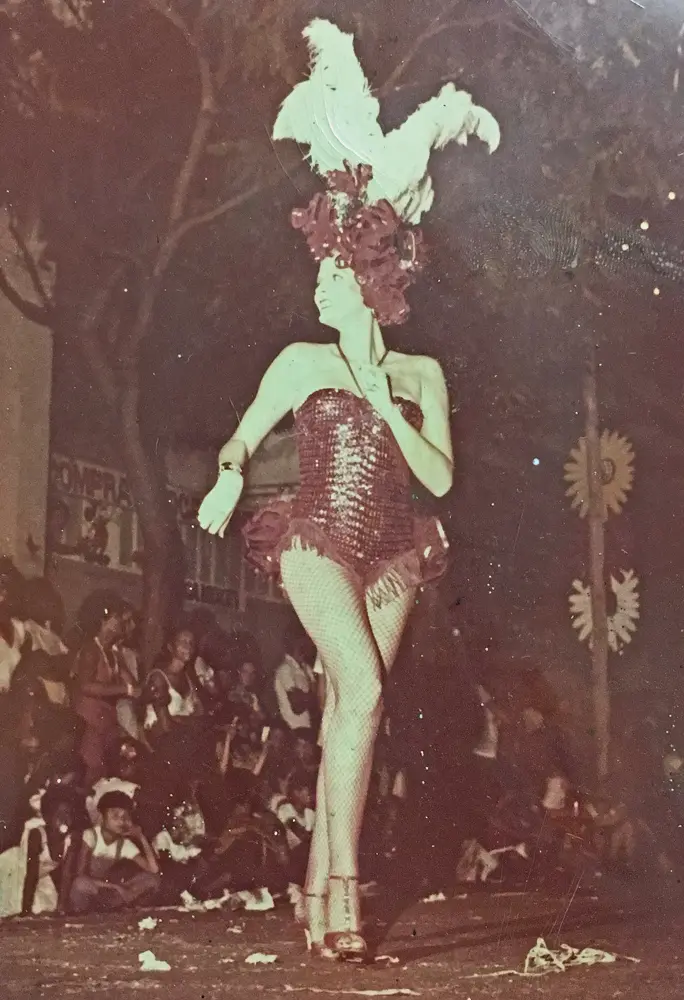
In 1976, under the military dictatorship in Brazil, Waldirene Nogueira was detained in the street, as a part of a routine police screening. The military dictatorships in Latin America were a time of extreme control of the civil population, with permanent police street screenings, military controls in the highways, and the vigilance of the secret service. As part of one of these routine controls, Waldirene Nogueria was detained and the police requested her ID. When the police officers noticed the incongruence between the male name in her ID and the actual female aspect of Waldirene, they started a deeper screening. They requested her to strip off, they noticed the external aspects of her genitals, and requested medical assistance to determine her sex. When the police medical service determined that Waldirene was born with male genitals, and she got her new genitals with a sex change surgery, they started a legal case against the surgeon Roberto Farina.
Before her detention, Waldirene lived a “normal life” working as a nail technician and studying English in a small town near to Sao Paulo. “My life before the surgery was an unbearable martyrdom because I had to deal with genitals that never fit on me. After the surgery, I became free forever, thank to God and Dr. Roberto Farina, the abominable organs that turned my life a hell. I felt too relieved that it seemed to have created new wings for life” declared Waldirene in the press. She was detained in 1976 and carried to Brazilia for a medical inspection consisting of putting into her body different instruments to determine her “real” sex. During her childhood Waldirene was a fan of actors of actresses of the glamorous Hollywood golden age. She makes a sketchbook with old pictures and clippings about her idols. But her life changed completely when saw for the first time a picture of the French vedette and actress Coccinelle. Under the influence of Coccinelle, many transsexual women in Latin America knew about the sex change surgeries. Waldirene is just one of many cases of the powerful influence of Coccinelle in the life of transsexual people.
Waldirene Nogueira, is one of the examples of transsexual people to choose to live a discreet life far from the camera lens and flashes. Even in her last interviews she refused to be portrayed because she still remembers the horror lived when the Police and medical services scrutinized her body and took pictures to register the “crime” committed against the sex. Invisibility was the response Waldirene found to manage her life, and her option to live in a time of violence like the dictatorship times in Brazil. The only picture that registered her naked body is in the records of justice and police as a memorial of discipline and punishment.
Marcia Alejandra Torres
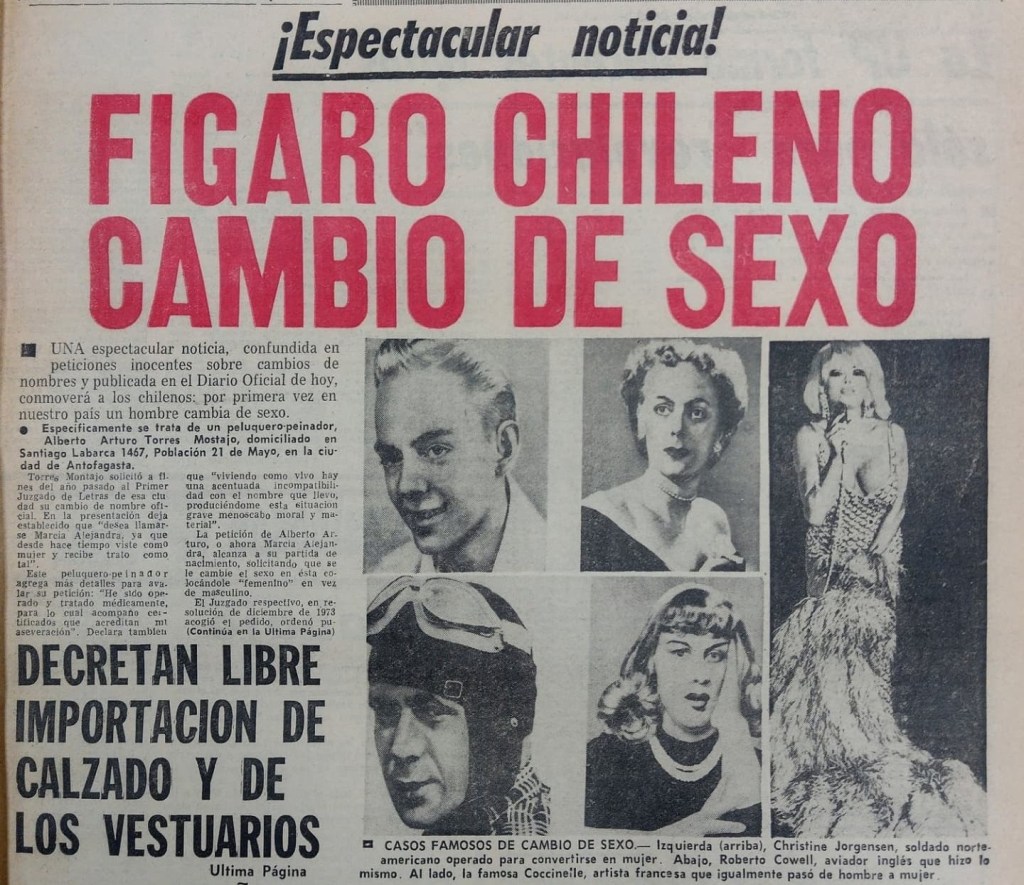
In 1973, Marcia Alejandra Torres became the first transsexual woman to get a sex change surgery in Chile. She was born in the northern city of Antofagasta and prior to her surgery worked as a stylist in her hair salon. During her childhood, she was raised in a working class family, her father was a well-known leader of the mines workers union. Because of the violence suffered in the school, Marcia started to work too early as a hairdresser. During her young years she knew a group of travestis vedettes that performed cabaret shows in the region, and joined them as customer and hairdresser. Was there that she learned about the hormones pills, the rudimentary techniques to dress like a woman, and the underworld. At the same time, she readed in a magazine about Coccinelle, and her tour across Latin America. That is how Marcia knew about the sex change surgery and hormone treatments performed in Europe and Morocco. At the beginning of the 70s Marcia read an open call published in the main newspaper announcing the work of the Department of Sexual Anthropology led by Dr. Osvaldo Quijada. Marcia contacted the doctor and started her journey looking a sex change surgery in Santiago de Chile. During some months she lived in the hospital and performed many screenings and tests until finally getting her surgery.
One of the central questions that Marcia had to answer during the test was about the sex work. A previous candidate to the surgery was rejected because she was engaged in sex work and under the consideration of the medical committee the people engaged in sex work can not be considered as “real” transsexuals, because many times the sex work includes the use of pennis in the sex relations. By the medical system, one of the main questions about the transexual bodies is if they used or not their penises, as an uncontroversial proof of their real inclinations to being women. Marcia denied to be engaged in sex work, and declared that any sexual activity was acceptable to her because of the uncomfortable relation with her genitals. Despite this official statement, in a recent interview she confessed that the last night before the surgery she masturbated herself like a farewell of their sex assigned a birth.
After the surgery Marcia became popular in the press and worked as vedette in many cabarets in Chile and Europe. Despite the similar situation in other countries of the region, even during the dictatorial government of Augusto Pinochet, Chile still performed sex change surgeries. According to the research of Fernanda Carvajal, the military regime used the sex change surgeries as an example of the good aspects of technology that permitted reformed the body and mind of trans people to leave the messy and undisciplined life of travestis to become normalized and correct women. In the press, the image of Marcia was used in this sense, showing her in two different aspects: an old picture when she was detained by the police during a travesti demonstration, and a new one after surgery when she is portrayed as a female and sexy artist. In this case, the visibility gained by Marcia after the surgery was tokenized by the military government to reinforce the moral ideals against no binarism, revolutionary actions and sex workers.
Juan Jose Cabezudo
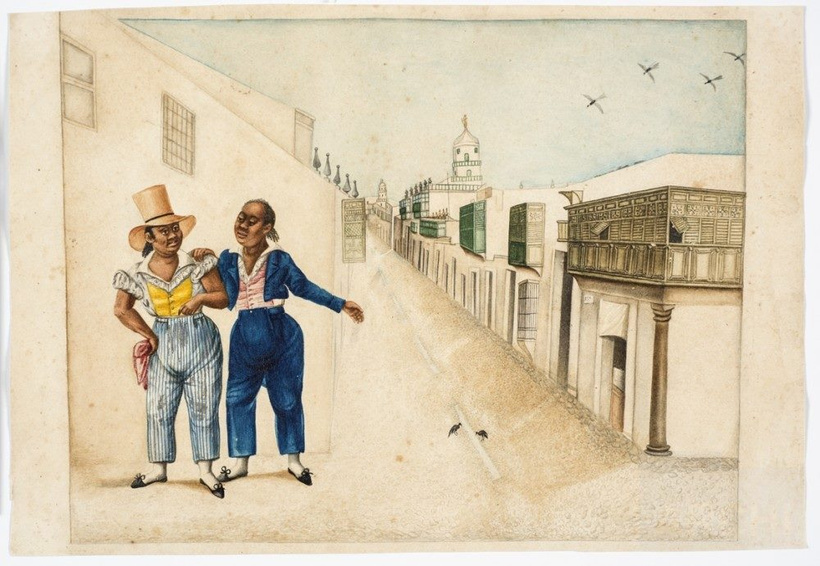
In the early years of the 19th century, under the colonial period in Peru, a very curious character attracted the attention of society. Juan Jose Cabezudo, also known as “lamesuelas” or “maricon”, was a black person, son of African slaves traded by the Spanish colonizers. Cabezudo had a small street food stall in the main square of Lima. Magally Alegre-Henderson in her research analyzes how the early years of the nineteenth-century was a time particularly tolerant with some racialized representation of the homosexuality, Juan Jose Cabezudo was one of these examples. Cabezudo was also portrayed in some canvas making by the costumbrista artist Pancho Fierro, and photographed by the artist Eugenio Courret. Juan Jose Cabeuzdo was a very popular character in the colonial period, because of his extreme talent to cook traditional dishes many requested by the colonial authorities, and because he dressed in female clothes in his daily life. But according to Allegre-Henderson, this open attitude with the homosexual people was accompanied with a mocking representation of the black and indigenous people, considered less valuable than the white masculinity.
***
Visibility is one of the central topics in Foucault’s theorization about the systems of vigilance and punishment. Panopticon architectural prison is the big symbol of the systems of vigilance implemented by the power to control the populations targeted as dangerous. In Discipline and Punishment, Foucault mentioned that “visibility is a trap” because many times, the device of visibility used by some population to demand recognition and justice also works as a device to expose the same population to the risk of being disciplined. In the current time, under the rise of right-wing and fascism in the world, the boundaries of visibility politics are more complex than the past decade. Under progressive governments the visibility of marginalized populations is a way to participate in political debate, request rights, and increase the silenced voices. But the same device of visibility built the structure to put people at risk. Also, visibility is always a privilege just available to some sectors of trans and queer populations, with the material conditions and security frames being exposed in front of the society. In some countries, regions, under determined regimes and contexts being visible it is not possible, at least without risks.
These examples also show how even under open frames of visibility, this device can be used as a way to target some populations, increasing racialization, building specific control devices, and using the trans and queer identity to justify conservative regimes. Despite any disapproval of the visibility as a valid political practice, this text just tries to call attention to the complexity behind visibility strategy. Sometimes visibility is impossible, a trap or difficult; sometimes it is a dangerous strategy that builds theoretical frames and information that can be instrumentalized by the power to build the bars of our own cell.
 Marce J. Butierrez
Leave a comment